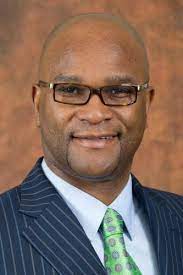
South Africa mourns the untimely passing of Ambassador Nkosinathi Mthethwa

The Government of the Republic of South Africa announces with deep sorrow and profound regret the untimely passing of His Excellency Ambassador Nkosinathi Emmanuel Mthethwa, South Africa’s Ambassador to the French Republic.


Ambassador Mthethwa was a distinguished servant of the nation, whose career was marked by dedicated service in critical ministerial portfolios, including Minister of Police and Minister of Sports, Arts and Culture. He also served on the Board of Directors for the 2010 FIFA World Cup Local Organising Committee. His lifelong commitment to public duty was further exemplified by his longstanding contribution to the African National Congress through its highest decision-making structures.


In his diplomatic role, to which he was appointed in December 2023, Ambassador Mthethwa was tasked with strengthening the vital partnership and bilateral ties between South Africa and France.


“I have no doubt that his passing is not only a national loss but is also felt within the international diplomatic community,” said Minister Lamola.


The circumstances of his untimely death are under investigation by the French authorities. The Government of South Africa extends its deepest and most sincere condolences to the family of Ambassador Mthethwa, and to his friends and colleagues during this period of immense grief. He is survived by his wife and children.


We honour his legacy of unwavering patriotism and service to our nation.


ISSUED BY THE MINISTRY OF INTERNATIONAL RELATIONS AND COOPERATION

SOCIAL MOVEMENT IN FRANCE- WHAT IS EXPECTED NEXT WEEK?

Without being able to predict the extent of these movements, here is what is announced for September 18, 2025:

    • Rail transport

Three unions, representing 70% of the votes in the last professional elections, have called for a strike on September 18. They encourage “all railway workers to mobilise massively on 18 September by striking and to participate in the demonstrations”.  As strikers are required to declare themselves 48 hours in advance in transport, traffic forecasts should be specified on Tuesday, September 16 at the end of the day.

    • RATP (urban public transport)

The transport lines managed by the RATP in Île-de-France, in particular the Métro, could be affected by this new mobilization. The four main unions have called for a strike on September 18.

    • Air sector

The mobilization could cause major disruptions in the air, as the majority union among French air traffic controllers has called for a strike on Thursday, September 18

The strike could also directly affect airlines. The unions represented at Air France are calling to join the mobilization on September 18 and have filed a strike notice for that day. The National Union of Airline Pilots (SNPL), the profession’s leading organisation, is not calling for a strike.

 To find out about the status of your flight, you can visit the airport’s website, your airline’s website, or the FlightAware, Flightstats and FlightRadar websites.

    • VTCs (Private hire taxis)

The union representing VTC drivers is calling on drivers to make their voices heard on September 18. A rally is planned in front of the Ministry of Labour in Paris.  The union also calls on its colleagues to “disconnect” from the platforms on that day and therefore not to accept clients.

    • Pharmacies

Hostile to the measure lowering their remuneration on generic medicines, pharmacists’ unions are calling for pharmacies to close on 18 September.  Pharmacists have until September 11 to declare themselves on strike to their Regional Health Agency (ARS). The prefects will then be able to make requisitions, if necessary, to ensure on-call duty and a supply of medicines.

    • Physiotherapists

Physiotherapists are called to close their practices on Thursday, September 18 by the main union of their profession.

    • Education

The mobilization should not spare the National Education, the teachers’ unions having joined the inter-union and its call for a general strike.

    • Electricity and gas

On strike since September 2, electricity and gas employees have been called to continue their mobilization until September 18, the day of inter-union strike.

PPROFESSOR PRISCILLA BAKER OF THE UNIVERSITY OF WESTERN CAPE (UWC) IS AMONG THE FIVE WINNERS OF THIS YEAR’S L’OREAL-UNESCO FOR WOMEN IN SCIENCE INTERNATIONAL AWARDS.

Professor of analytical chemistry at the University of the Western Cape (UWC), Priscilla Baker, is among five winners of this year’s L’Oréal–UNESCO For Women in Science International Awards.

These researchers have been recognised for their contributions to physical sciences, mathematics and computer science at the UNESCO headquarters in Paris, on June 12.

Professor Baker was honoured for her contribution in the field of electrochemical microsensors for detecting contaminants in the environment, with applications in pharmaceuticals, food, health and energy.

According to a statement, her dedication as a mentor in analytical electrochemistry has empowered students and early-career scientists to undertake innovative research projects in this field.

She was named as the winner, also referred to as the laureate, for Africa and the Arab states.

Growing up in Bellville South, Baker said she sometimes went to her old high school to motivate learners.

She graduated with a BSc in Physical Oceanography from the University of Cape Town in 1990. “The practical component of oceanography required long periods at sea, but the boats were not equipped for women, and the crew were not ready to accept a person of colour as a professional,” she said.

She then shifted to analytical chemistry, excelling under the mentorship of Professor Andrew Crouch and later earned her PhD in Chemistry from Stellenbosch University.

Professor Baker is also the co-director of the SensorLab research group at UWC with Prof Emmanuel Iwuoha.

27 YEARS OF EMPOWERING WOMEN IN SCIENCE

Today, women still only account for just over one in three researchers globally (31.1%) according to UNESCO data.

That is why the Fondation L’Oréal and UNESCO have been working together for 27 years through the For Women in Science Programme to empower and promote women in science. By supporting them to overcome barriers and advance their careers, this long-lasting partnership enables women scientists to contribute to pushing the frontiers of knowledge and solving the major challenges of our time – for the benefit of all.

Since its creation, the L’Oréal–UNESCO For Women in Science Programme has celebrated and supported more than 4700 women for the excellence of their research, including 137 laureates of the International Awards and more than 4500 young female researchers. Among the Laureates, seven have received a Nobel Prize in science.

WORKING VISIT BY THE DEPUTY-PRESIDENT OF THE REPUBLIC OF SOUTH AFRICA PAUL MASHATILE: A SUCCESS TO BE CONTINUED

COMMUNIQUÉ

WORKING VISIT BY THE DEPUTY-PRESIDENT OF THE REPUBLIC OF SOUTH AFRICA PAUL MASHATILE: A SUCCESS TO BE CONTINUED

The Embassy of South Africa to France would like to thank all the stakeholders and partners who made the working visit of Deputy-President of the Republic of South Africa Paul Mashatile to Paris a success. For four days (from 20 to 24 May 2025), the Deputy-President and his high-level delegation comprising ministers, deputy ministers, senior government officials from both the public sector and CEOs of state-owned enterprises as well as business leaders, explored existing business and new economic trade relations between South Africa and France through round tables, interviews and site visits of major French companies (RATP, Suez Global Waste Management Company, Dassault Systèmes and Meridiam).

The highlight of this visit was the South-Africa-France conference on investments held on Wednesday 21 May in the presence of a hundred South African companies and numerous representatives of major French groups.

This conference offered investors the opportunity to explore diverse investment opportunities in key sectors, such as agriculture, mining, green manufacturing, and tourism, while also fostering new trade and investment avenues, exchanging ideas, and forging partnerships to drive our economies forward.In addition, the Conference consisted of a high-level segment by government officials who led on thematic discussions related to investment opportunities, policies, and the investment climate in South Africa.

This conference, which was of an exceptional level and attendance, led to the following conclusion: South Africa is and remains a country open to investment and international trade and France has many opportunities to seize in this context.

In his speech to a large audience, the Deputy-President of the Republic of South Africa stressed: “South Africa remains a competitive business and investment hub despite global economic challenges. Our goal is to unlock significant opportunities across various sectors, promoting sustainable economic growth and inclusive development while maximising trade and investment opportunities.”

As part of his programme, Deputy President Mashatile delivered an address at UNESCO’s headquarters in the context of the Transforming MEN’talities campaign, an initiative aimed at changing mindsets and promoting gender equality.

On the 22nd of May, the Deputy President met with His Excellency Emmanuel Macron, President of the French Republic, where discussions focused on strengthening trade and diplomatic cooperation as well as cooperation in multilateral fora.

President Macron welcomed the outcome of the conference to host the “Investment Conference” on a biennial basis to take stock of established partnerships and explore other areas of cooperation. The Deputy-President Paul Mashatile, for his part, committed to stenghening the economic relations between the two countries and doubling trade with France.

The day after, the Deputy President of the Republic of South Africa met with his counterpart, Prime Minister of the French Republic François Bayrou, who appreciated the success of the inaugural South Africa-France Investment Conference that allowed businesses to present South Africa as an attractive investment and trade destination.

The South African Embassy in Paris

26/05/2025

NINTH MEETING OF THE SOUTH AFRICA-FRANCE FORUM FOR POLITICAL DIALOGUE

NINTH MEETING OF THE SOUTH AFRICA-FRANCE FORUM FOR POLITICAL DIALOGUE

The Minister of International Relations and Cooperation of the Republic of South Africa, Mr Ronald Lamola, arrived in France to co-chair the Ninth Forum for Political Dialogue alongside the Minister for Europe and Foreign Affairs of the French Republic, Mr Jean-Noël Barrot.

This bilateral engagement enabled the two Ministers to review progress and discuss key issues of mutual interest, further strengthening the strategic partnership between South Africa and France.

South Africa enjoys robust trade relations and significant investment flows with France, which remains one of its largest trading partners within the European Union. The two nations also collaborate strategically in critical areas such as education and skills development science, technology, arts, and culture, energy cooperation, health and defence.

The Forum further provided an opportunity for the Ministers to exchange perspectives on pressing global and regional geopolitical developments, underscoring their shared commitment to multilateralism and a rules-based international order.

This dialogue reaffirms the enduring partnership between South Africa and France, rooted in mutual respect and a common vision for advancing peace, sustainable development, and innovation.


16 MAY 2025

ISSUED BY THE MINISTRY OF INTERNATIONAL RELATIONS AND COOPERATION

FROM THE DESK OF THE PRESIDENT

Dear Fellow South, African,


I have just returned from a Heads of State summit in Tanzania on the conflict in the eastern DRC. The outcomes of the summit provide a beacon of hope for the troubled eastern Democratic Republic of Congo.

The historic joint summit brought together the East African Community (EAC) and the Southern African Development Community (SADC) to consider the deteriorating security situation in the eastern DRC and to find a sustainable political solution.

As a member of SADC and the African Union, we have a responsibility to support all efforts to bring peace and stability to our fellow African nation, which has been racked by war for more than three decades.

Our country contributes troops to the United Nations Organisation Stabilisation Mission in the DRC (MONUSCO) and the SADC Mission in the DRC (SAMIDRC).

A few weeks ago, 14 South African National Defence Force (SANDF) troops paid the ultimate price for their efforts to restore peace to the region. The deaths of our soldiers alongside troops from other African nations signalled an alarming escalation in the conflict.

The strategic city of Goma in the eastern DRC is now under the control of the M23 rebel group fighting the Congolese army, with the M23 having made advances in other towns.

As South Africa we have steadfastly maintained that diplomacy is the most sustainable solution to this conflict. While we are involved in peacekeeping missions, South Africa actively participates in the various diplomatic efforts to end the conflict in the eastern DRC.

These include the Peace, Security and Cooperation Framework for the DRC and the Great Lakes Region, the Luanda Peace Process led by the President of Angola, and the EAC-led Nairobi Process facilitated by former president of Kenya President Uhuru Kenyatta.

As South Africa, we have always believed that the best way to resolve a conflict is to ensure that all parties to the conflict are involved in the negotiations that lead to the resolution of the conflict, whether they are state actors or non-state actors. We are pleased that this approach was adopted and reconfirmed at the SADC extraordinary summit held in Harare, Zimbabwe two weeks ago.

Several of the countries in the EAC bloc, such as Uganda, Burundi, Tanzania and Rwanda, share borders with the DRC and are directly impacted by the ongoing conflict. It was therefore significant that the Heads of State of these countries and the President of the DRC were at the joint summit.

Having considered a report on the security situation in the eastern DRC, the summit reiterated the call for an immediate ceasefire and a cessation of hostilities between the warring parties. A ceasefire will allow humanitarian aid corridors to operate and bring much needed supplies to the civilians caught in the crossfire.

The summit directed that the EAC/SADC Chiefs of Defence Forces meet within five days to develop a securitisation plan for Goma and the surrounding area, the reopening of Goma airport, the evacuation of civilians and the repatriation of the deceased.

One of the most significant outcomes was that the joint summit agreed that direct negotiations and dialogue resume between all state and non-state parties, including the M23. This will take place under the framework of the Luanda and Nairobi processes.

We are pleased that this inclusive approach was endorsed and adopted at the historic joint EAC/SADC summit under the leadership of President William Ruto of Kenya and President Emmerson Mnangagwa of Zimbabwe.

This is a major step forward. Unless all parties to the conflict are brought around the negotiating table, all diplomatic solutions will lack credibility and be unsustainable in the long term.

The joint summit affirmed the independence, sovereignty and territorial integrity of the DRC. This means that a process must be developed for uninvited foreign armed forces to withdraw from the DRC.

The outcomes from the joint summit are in essence confidence-building measures towards a sustainable peace.

These confidence building measures will finally lead to the drawdown of the SAMIDRC troops.

This historic summit of the EAC and SADC paves the way for a lasting peace in the eastern DRC.

During the country’s colonial occupation, the great Congolese revolutionary and statesman Patrice Lumumba once said:

“We are not alone. Africa, the free peoples and the peoples fighting for their freedom in all corners of the world will always be side by side with the millions of Congolese who will not give up the struggle.”

South Africa stands in solidarity with the Congolese people and their aspiration to live in peace and security. We support their right to live free from forces that violate their human rights, plunder their natural resources and terrorise their communities.

We reaffirm our commitment to a diplomatic and political solution that prioritises the stability of the DRC and neighbouring countries and safeguards the peace and well-being of the Congolese people.

With best regards,


Cyril Ramaphosa

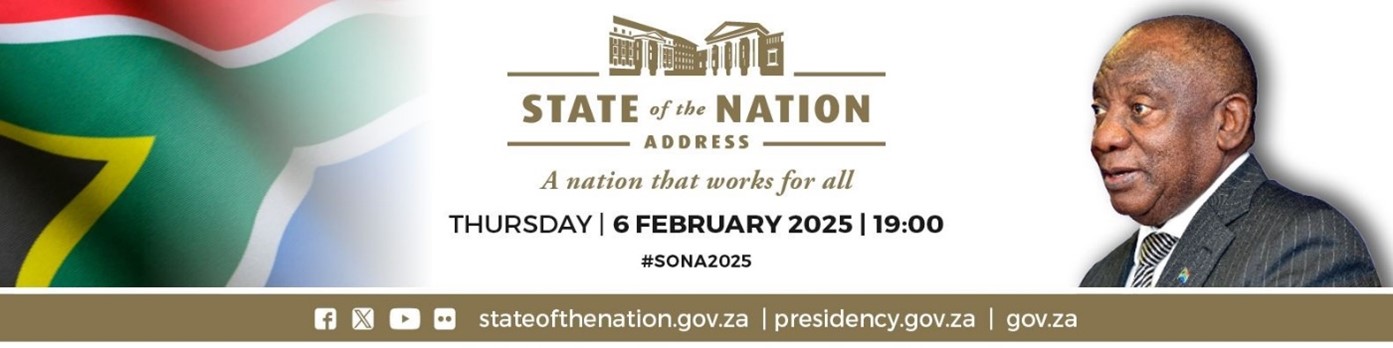
President Cyril Ramaphosa delivered the State of the Nation Address (SoNA)

President Cyril Ramaphosa delivered the State of the Nation Address (SoNA) on Thursday, 6 February 2025 at 7pm. The address took place before a joint sitting of the two houses of Parliament. The theme for the 2025 SoNA is a “A nation that works, for all”.

The address is an important milestone as it brings certainty to the country’s political, social and economic landscape. It demonstrates that South Africa’s democracy remains robust.

In the address, President Cyril Ramaphosa sets out government’s key policy objectives and deliverables for the year ahead, flag challenges and outline interventions to unlock our nation’s potential.

During his address, the President also highlights what has been achieved since his last address in 2024. He also reflects on the progress made in implementing the Economic Reconstruction and Recovery Plan (ERRP).

For the full speech, click on the following link:

https://www.stateofthenation.gov.za/assets/downloads/SONA_2025_Speech.pdf

Presentation to Paris-based organisations of South Africa’s priorities for the G20 presidency


Presentation to Paris-based organisations of South Africa’s priorities for the G20 presidency

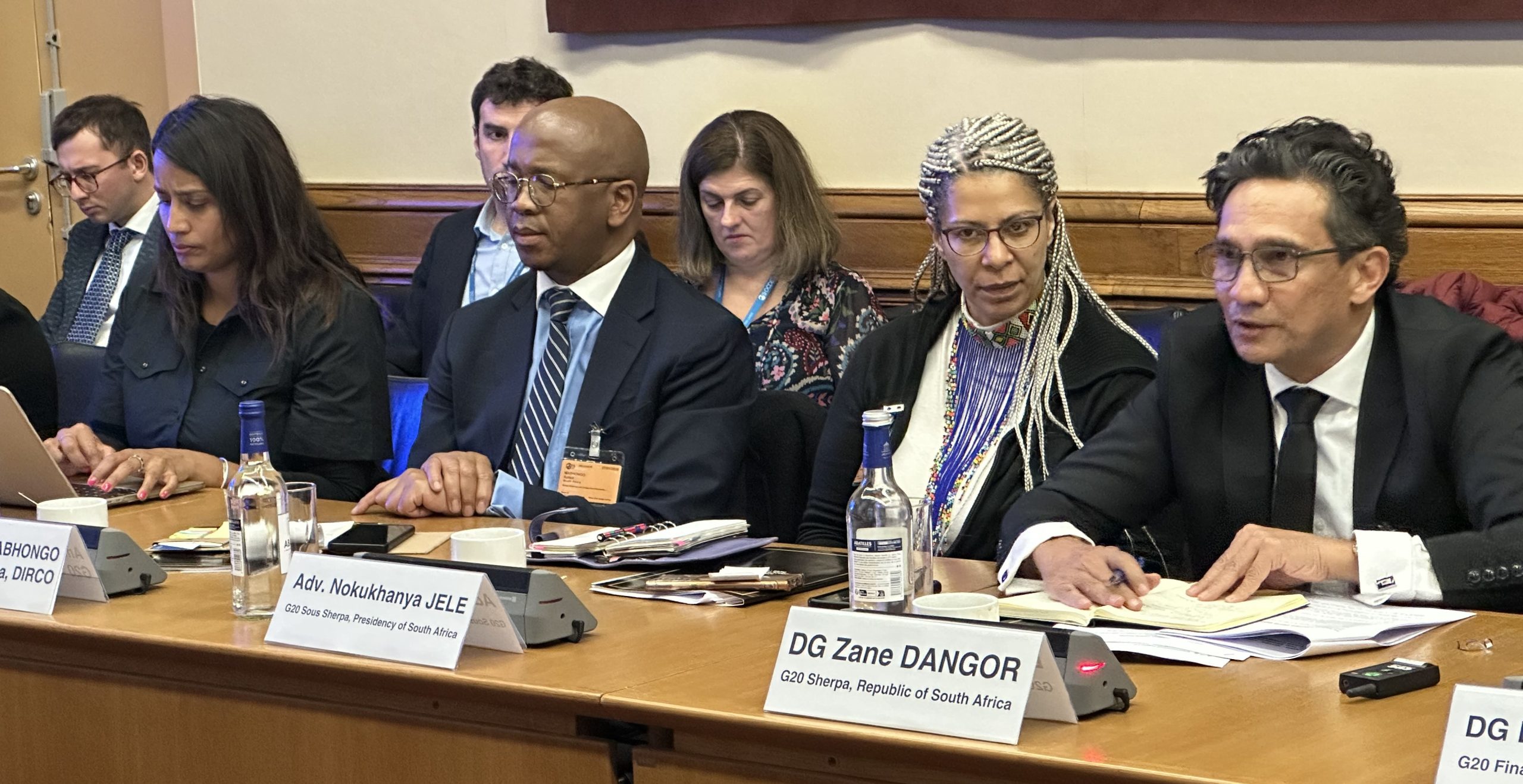
Mr Zane Dangor, Director General of the Department of International Relations and Cooperation (DIRCO), in his capacity as G20 Sherpa, and Mr Duncan Pieterse, Director General of National Treasury, accompanied by two Sous-Sherpas, and Officials from DIRCO held several meetings with Paris-based organisations (UNESCO, OECD, IAE) on 27-28 January 2025. The South African delegation presented South Africa’s priorities of its G20 presidency for 2025.


FROM THE DESK OF THE PRESIDENT

In the world of today, no country can go it alone

Dear Fellow South African,

Last week, I led a South African delegation to the World Economic Forum (WEF) annual meeting in Davos, Switzerland. Every year in January thousands of leaders from government, business and other sectors gather in this town in the Alps to discuss the state of the global economy.

The South African delegation that arrived in Davos was upbeat, confident that we are overcoming the challenges that we face. Our democracy is thriving. Our energy challenges are now a story of opportunity.

This year, South Africa was invited to present its priorities for its G20 Presidency. In a plenary address and in a separate discussion with business leaders, we outlined our theme for the G20 this year – Solidary, Equality, Sustainable Development – and the focus areas through which we will give meaning to this theme.

We made the point that it is in the interests of all countries, large and small, wealthy and poor, to reduce global inequality. That is why one of our priorities is ensuring debt sustainability for low-income countries. By freeing up funds for debt relief in these countries, they will be in a better position to invest in infrastructure, industrial development, education, health care and other forms of development.

Another focus area, which both reduces poverty and promotes sustainability, is the mobilisation of finance for a just energy transition. Through this, developing economy countries will be able to pursue a low-carbon development path while protecting the interests of affected workers, businesses and communities. Related to this is another focus area: the mobilisation of special financing and insurance to enable vulnerable countries to rebuild after being struck by natural disasters.

The fourth focus area is to harness critical minerals, which are abundant in Africa and other countries of the Global South, to promote inclusive growth and development. We are proposed a G20 framework on ‘green’ industrialisation so that countries endowed with these resources must be the ones that benefit most.


We stressed that our themes and priorities are underpinned by the principle of cooperation. Throughout history, human progress has been possible only through collaboration among peoples and countries. We therefore renewed our call for the resolution of global challenges through multilateral actions. We called for inclusive solutions that recognise that the world is more interconnected than ever before.

Cooperation is vital if we are to overcome the existential threat of climate change. Carbon emissions into the atmosphere, global warming and the extreme weather events that it causes do not recognise national boundaries or political systems. Although the poor are most vulnerable, the effects of climate change threaten everyone.

As we saw during the Covid pandemic, the same is true of pandemics and other health emergencies. Conflict in one part of the world impacts on countries in other parts of the world. Trade wars, especially between large economies, weakens the global economy and holds back inclusive growth and development for all.

In the world of today, no country can go it alone. No country can sustain its growth, stability and development without working together with other countries to overcome common problems.

South Africa’s message resonated with the participants in Davos. It was a sentiment shared by many of the business leaders with whom we interacted, as well as with other heads of state and multilateral institutions.

Many of the people we spoke to endorsed South Africa’s G20 priorities. They saw the value of our focus on Africa and the interests of countries with developing economies. They appreciated the importance of reducing inequality within and between countries and the need for new growth paths that are climate-friendly sustainable.

We also noticed a much improved sentiment towards South Africa and the prospects for our economy in the years ahead. They commented on the successful transition from the 6th to the 7th administrations and the formation of the Government of National Unity. They saw this as a sign of stability and a common commitment among parties to inclusive growth, employment and a capable state. They welcomed the far-reaching reforms that are underway in areas such as energy, logistics, telecommunications and water to grow and transform our economy.

The South African delegation left Davos with a sense that there are many leaders in the world that share our vision of an inclusive, just and equal world. And that they are prepared and willing to work with us through our G20 Presidency towards the achievement of such a world.

With best regards,

Cyril Ramaphosa